
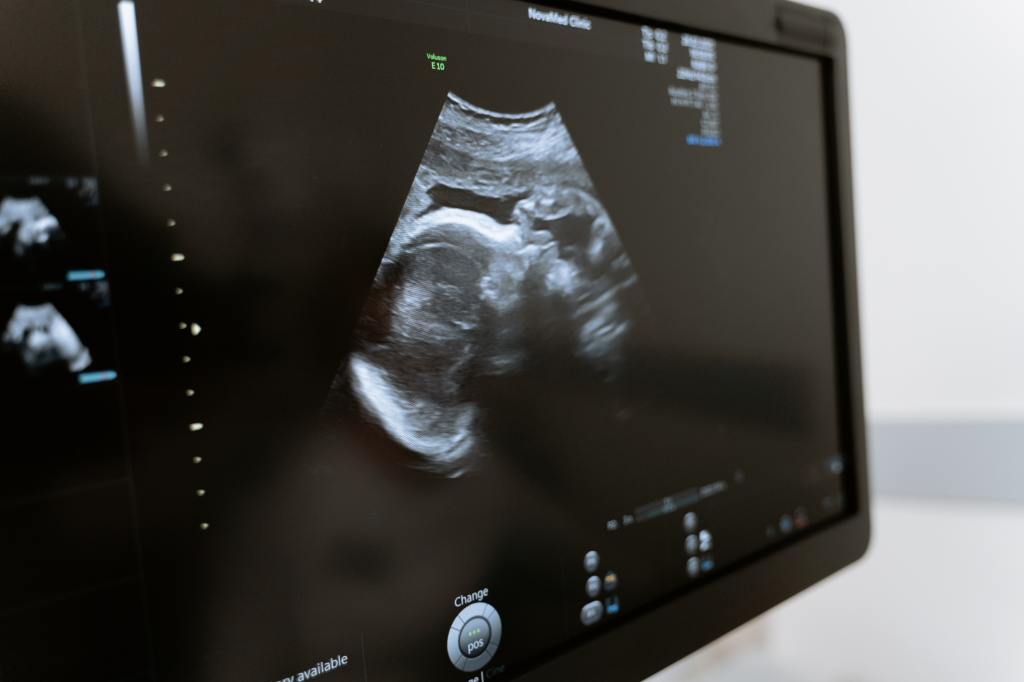
Ultrasound is a powerful diagnostic tool that is increasing in popularity in Low and Middle Income countries (LMICS) due to advances in affordability, availability, portability and durability of the machines [1]. Ultrasound waves are emitted by a transducer which also detects the echoes reflected back in order to produce an image.
It is a valuable tool in all trimesters of pregnancy. In LMICS, Ectopic pregnancies are the leading cause of mortality in women during the first trimester [1]. This is mainly due to the fact that we are unable to rely on signs and symptoms to narrow down the diagnosis. Ultrasound can help reduce maternal mortality as it helps to diagnose and determine the exact location of an ectopic pregnancy [2]. A study done in the United States, where new protocol was instituted for bedside ultrasound in evaluating patients with first trimester bleeding, decreased the delay in diagnosis of ectopic pregnancy from 43% to 29%. Furthermore, it decreased the rate of missed ruptured ectopic pregnancy from 50% to 9% [3].
Furthermore, ultrasound is vital in estimating gestational age in the second and third trimester of pregnancy. This is very helpful in the management of preterm labour and ultrasound allows this diagnosis to be carried out successfully by non-obstetric specialists with a high degree of sensitivity [1]. Ultrasound also helps to diagnose multiple gestations, accurately follow up foetal growth, detect foetal anomalies, and placental location and implantation [2]. In addition to this, there have been literary reports of improved mother foetal bonding due to these scans [4].
It is a vital piece of equipment for the developing world as it helps to produce a more thorough differential diagnosis as well as helping to narrow down the diagnosis in order to create a better management plan. In Monrovia, Liberia a study showed that ultrasound changed the patient management in 62% of cases in the major tertiary care centre. Of which, the greatest impact was on patient management after the first trimester obstetric ultrasound [5].
In rural Zambia, over a 6 month training period 441 ultrasounds were performed with the main abnormal findings being non-vertex presentation (61%), multiple gestations (24%) and no foetal heart rate. This prompted change to 17% of the clinical decision-making and 100% of the midwives reported that ultrasound improved their practice and changed their management for the better [6]. This shows that not only can the Ultrasound machine help to increase medical accuracy and improve patient care but it also empowers the healthcare professionals who use it in order to make a more educated diagnosis.
To conclude, I have chosen the ultrasound machine as it helps to reduce maternal mortality by identifying risks early and adapting management plans accordingly. Furthermore, it helps to reduce both pre and peri natal mortality which alongside maternal mortality remains the biggest disparity between low income and high income countries. Finally, an ultrasound machine is multi-purpose and can be used as both a diagnostic and therapeutic tool.
1.Sippel, S., Muruganandan, K., Levine, A. and Shah, S. (2011). Review article: Use of ultrasound in the developing world. International Journal of Emergency Medicine, [online] 4, p.72. doi:10.1186/1865-1380-4-72.
2. Abramowicz, J.S. (2013). Benefits and risks of ultrasound in pregnancy. Seminars in perinatology, [online] 37(5), pp.295–300. doi:10.1053/j.semperi.2013.06.004.
3. Mateer, J.R., Valley, V.T., Aiman, E.J., Phelan, M.B., Thoma, M.E. and Kefer, M.P. (1996). Outcome analysis of a protocol including bedside endovaginal sonography in patients at risk for ectopic pregnancy. Annals of Emergency Medicine, [online] 27(3), pp.283–289. doi:10.1016/s0196-0644(96)70260-3.
4. Ji, E.-K. ., Pretorius, D.H., Newton, R., Uyan, K., Hull, A.D., Hollenbach, K. and Nelson, T.R. (2005). Effects of ultrasound on maternal-fetal bonding: a comparison of two- and three-dimensional imaging. Ultrasound in Obstetrics and Gynecology, [online] 25(5), pp.473–477. doi:10.1002/uog.1896.
5. Kotlyar, S. and Moore, C. (2008). Assessing the utility of ultrasound in Liberia. Journal of Emergencies, Trauma and Shock, 1(1), p.10. doi:10.4103/0974-2700.41785.
6. Kimberly, H.H., Murray, A., Mennicke, M., Liteplo, A., Lew, J., Bohan, J.S., Tyer-Viola, L., Ahn, R., Burke, T. and Noble, V.E. (2010). Focused Maternal Ultrasound by Midwives in Rural Zambia. Ultrasound in Medicine & Biology, [online] 36(8), pp.1267–1272. doi:10.1016/j.ultrasmedbio.2010.05.017.
 Youth MedAid